1 of 5
A request starts a review
A book challenge is a request for a school to review a book. The request starts a review, not an automatic removal.
In November 2021, Brooke Stephens signed nine requests to remove books from Legacy Junior High. This form records one request and her answers.
From the form · Drama · November 13, 2021
“Have you examined this material in its entirety?”
“No”
In the next field, Stephens describes working with teams reviewing literature in public schools.
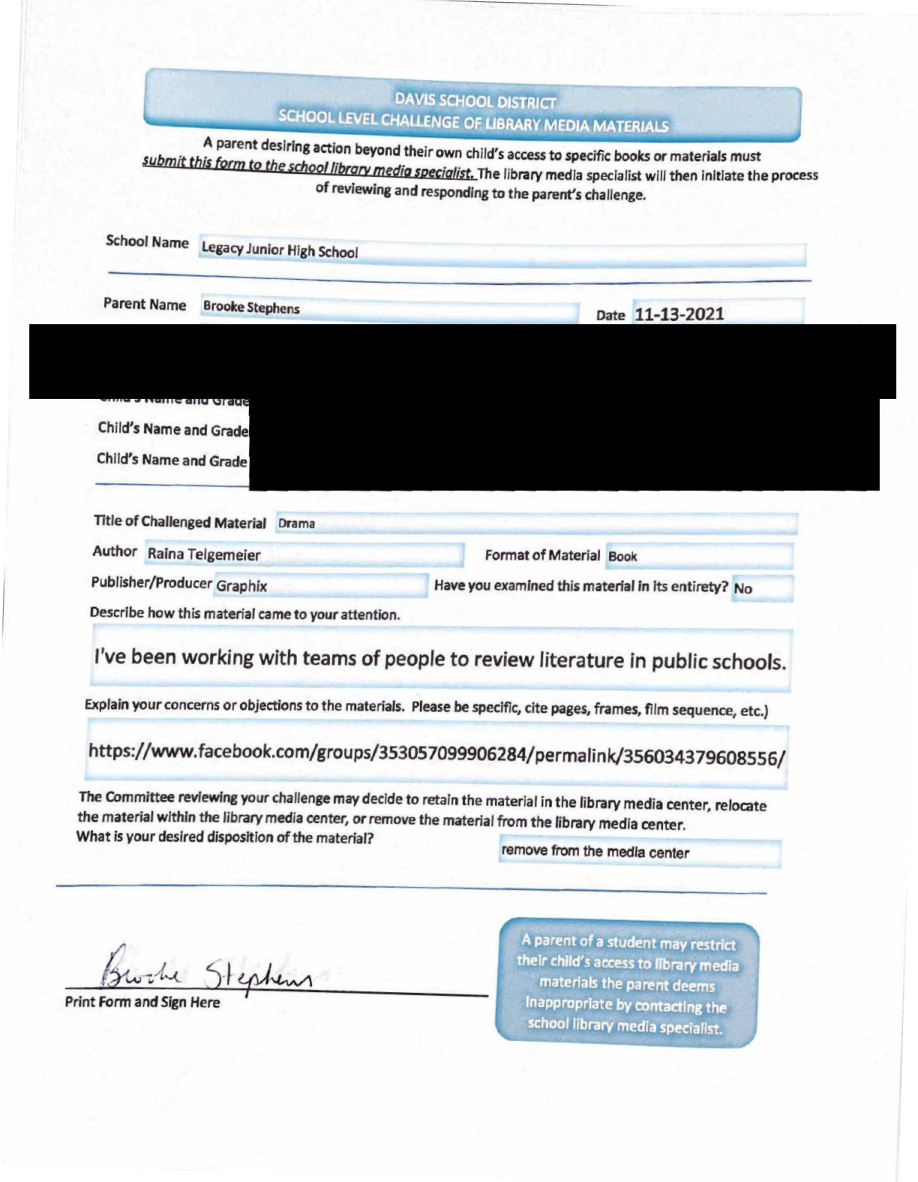
November 13, 2021 · Davis
What the forms tell us
The forms show who requested the reviews and the answers she gave. To learn what each review team read or decided, we need the review records as well.
Stephens signed nine school-level challenge forms dated November 13 for Drama, This One Summer, Monday’s Not Coming, George, Eleanor and Park, The Invisible Life of Addie LaRue, Crank, Extremely Loud and Incredibly Close, and Looking for Alaska.
All nine answer “No” to “Have you examined this material in its entirety?” The forms say “I’ve been working with teams of people to review literature in public schools” and request removal from the media center.
2 of 5
Private lists and ratings
Before the RatedBooks website, a spreadsheet collected book titles from other groups and identified schools that had them. Later tools offered ratings, excerpts and instructions for filing book challenges.
RatedBooks is a private book-rating service. Its ratings are not legal decisions about whether a school must remove a book.
What the record shows
How auditors used a private list
In 2025, an unnamed legislator supplied state auditors with a list of 186 RatedBooks titles. Auditors used the list to select books for review and read the selected books in full.
The audit documents how auditors selected books. To find out whether a district relied on a private rating, we need that district’s review records.
Where the lists and challenge tools came from
The list before the ratings follows the surviving spreadsheet and archives. From ratings to challenges examines the published guides and tools. A guide recommending a rating is different from a school relying on it.
3 of 5
Who has the authority to decide?
A person can include a private report with a book challenge. The report does not require a school to remove the book. Utah law sets the standards. Reviewers, school boards and state officials have different jobs.
- Local reviewersReview the book under the applicable standards and record their findings.
- Local school boardsHear appeals and vote in public meetings.
- Utah lawmakers and the State Board of EducationLawmakers set the law. The State Board of Education adopts rules for the process.
Follow the review process and check the law and rules:
Next: How removals become statewide →4 of 5
How removals become statewide
Under the 2024 statewide-removal process, final findings of “objective sensitive material” from a few school systems can require removal from student access across Utah public schools.
- Local findingsReviews find objective sensitive material.
- A statewide countAt least 3 districts, or 2 districts and 5 charter schools.
- Statewide removalThe requirement reaches other public schools.
That can affect a school whose own district never reviewed the book. The State Board has a separate process to review the statewide requirement.
What does “objective sensitive material” mean?
It is a legal category covering certain sexual content. It is not the same as a private rating, an objection to a book, or a finding about its overall literary value. The chapter links the law, rules and dated state records.
Check the statewide process and its source records:
Next: What families can do →5 of 5
What can families do next?
A local appeal and a later statewide review are different processes. Davis limited the Bible, then its board restored access for all grades on appeal. That local result does not mean a district can lift a statewide restriction on its own.
Start with the decision record: who decided, what reason did they give, and what appeal or review does the policy allow? For a book’s current status, check your district’s notices and library catalog.
See how a local appeal worked and how it differs from statewide review:
What if a record is missing?
A missing record leaves a question unanswered. We identify the records needed to check what was requested, decided or reported.
What a state records officer said about later review
A local appeal and a later statewide review are different processes. In a September 21, 2026 email, USBE Records Officer Ben Rasmussen described his understanding after the Board’s review window: “there is no current process to revisit the matter.”